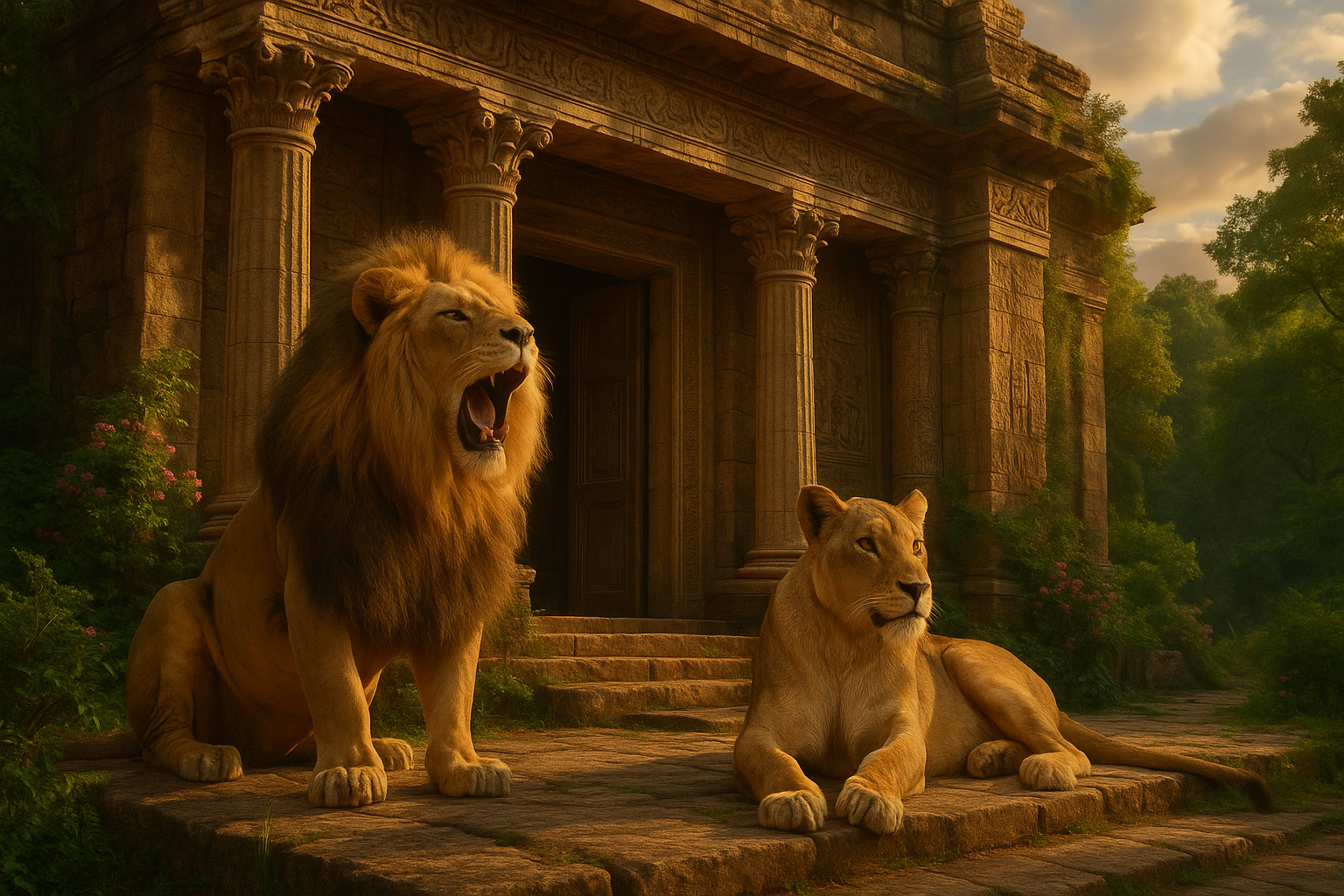
In the vast tapestry of history, where legends intertwine with reality, the lion emerges not just as a creature of the wild, but as an emblem of strength, courage, and divinity. Picture this: the golden hue of the setting sun casting long shadows on the ancient temples, where majestic lions stand as eternal sentinels, their gaze unwavering, their presence formidable. 🦁 These aren’t just any lions; they are the Roaring Protectors, guardians of sacred spaces that have withstood the ravages of time.

As you stroll through the ruins of ancient civilizations, from the mystic lands of Egypt to the lush terrains of India, you’ll find that lions have been carved into stone, etched into lore, and revered as more than mere animals. But what is it about these magnificent creatures that inspired such veneration? What stories do these silent guardians have to tell, and why were they chosen as the protectors of places deemed holy and untouchable by mortals?
The lion, often associated with royalty and bravery, finds its presence embedded in the very foundations of numerous temples. These structures, rich in history and architectural brilliance, are not just places of worship but are monuments to human creativity and devotion. Within their walls, the lion stands as a symbol of protection and power, embodying the divine force that guards against evil and chaos.
In this exploration, we will journey through time and space, traversing continents to uncover the stories of these Roaring Protectors. From the enigmatic sphinxes of Egypt to the regal lion sculptures of Indian temples, each narrative weaves a tale of cultural significance and spiritual symbolism. We will delve into the mythology that surrounds these creatures, unraveling the mysteries of why ancient cultures held them in such high esteem.
Our journey will begin in Egypt, where the lion’s image is often associated with the sun god Ra and the fierce goddess Sekhmet. Here, lions were not only protectors but also symbols of fierce wrath and healing powers. We will explore how these attributes were reflected in the architectural marvels of ancient Egypt, and what these connections reveal about the civilization’s understanding of the natural and divine world.
Next, we will traverse to the lands of Mesopotamia, where lions adorned the gates of mighty cities, embodying the power and authority of kings and deities alike. In this segment, we will uncover how these representations reinforced the rule of law and divine order in societies that revered cosmic harmony and balance.
Our exploration will then lead us to the heart of Asia, where the lion’s image was adapted into the majestic stone guardians of Chinese temples. Known as ‘foo dogs’, these stylized lions are believed to ward off evil spirits, serving as protectors of both the physical and spiritual realms. We will delve into the intricate artistry of these sculptures and their evolution over centuries.
In India, the lion becomes an avatar of Vishnu, the preserver god, and a symbol of enlightenment and sovereignty. The majestic lions of the Indian subcontinent stand not just at temple gates but also find their place in the rich tapestry of Hindu mythology. Through this lens, we will explore how these symbols influenced the architectural and spiritual landscape of ancient India.
As we weave through these diverse cultures and epochs, we’ll also touch upon the modern implications of these ancient symbols. How have these lions influenced contemporary architecture and art? What lessons do these majestic guardians offer in today’s world, where the balance between nature and civilization remains a pressing concern?
This narrative is not merely a recounting of history but a quest to understand the enduring legacy of lions as majestic guardians. Their stories, etched in stone and memory, continue to roar through the ages, reminding us of a time when the line between the mortal and the divine was guarded by these noble creatures. Through this exploration, may we find not only knowledge but inspiration to recognize the guardians in our own lives and the sacred spaces we hold dear. 🌟
Conclusion
## Conclusion
The majestic lion statues that stand guard at temples across Asia represent far more than decorative architectural elements. These roaring guardians embody centuries of spiritual tradition, cultural exchange, and artistic mastery. From the fierce foo dogs of Chinese temples to the protective singha of Southeast Asian Buddhist shrines, these stone sentinels have watched over sacred spaces and their devotees through countless generations. Their presence speaks to humanity’s enduring need for symbols of protection, strength, and divine authority. Whether carved from granite, marble, or bronze, each lion carries with it the hopes and beliefs of the communities that created them, serving as a bridge between the earthly and spiritual realms.
What makes these temple lions particularly fascinating is their ability to adapt and evolve while maintaining their core symbolic meaning. As Buddhism and other religious traditions traveled along ancient trade routes, the iconography of protective lions traveled with them, transforming to reflect local artistic styles and cultural interpretations. Yet regardless of their specific form, these guardians consistently represent the same fundamental principles: the triumph of good over evil, the protection of sacred wisdom, and the unwavering strength of faith. They remind us that while empires may rise and fall, the human desire for spiritual protection and guidance remains constant across time and geography.
The next time you encounter these magnificent creatures flanking temple gates or perched atop pedestals, take a moment to appreciate the rich tapestry of history and meaning they represent. These roaring guardians are not merely relics of the past but living symbols that continue to inspire reverence, wonder, and contemplation in all who pass beneath their watchful gaze.